Self-Hosted Nextcloud vs Commercial Cloud: 4TB NAS Pays Off
Advertisements
Tired of endless monthly subscription fees just to keep your files accessible? The debate over Self-Hosted Nextcloud vs Commercial Cloud is shifting fast as tech-savvy users realize that renting server space offsite often drains budgets far more than owning dedicated infrastructure.
By deploying a 4TB network-attached storage system at home, you reclaim total control over personal data privacy while eliminating recurring costs. This upfront hardware investment rapidly breaks even, transforming ongoing digital overhead into long-term financial independence.
Breaking free from proprietary subscription models gives you complete data sovereignty and scalable local performance. Taking charge of your private server setup is no longer just a hobby for enthusiasts—it is the smartest move for your wallet.
The Rising Trend of Self-Hosted Nextcloud
The movement towards self-hosting solutions like Nextcloud is not merely a niche trend but a significant shift driven by escalating concerns over data privacy and the long-term costs associated with commercial cloud providers. Users are increasingly seeking alternatives that offer greater control over their digital assets.
This paradigm shift reflects a broader desire for digital autonomy, where individuals and organizations prefer to manage their own data infrastructure rather than relying on third-party services. The allure of self-hosting lies in its promise of enhanced security, customizable features, and predictable expenditures.
Nextcloud, as an open-source platform, provides a robust framework for file synchronization, sharing, and collaboration, mirroring many functionalities of commercial offerings. Its flexibility allows for deployment on various hardware, including cost-effective NAS devices, making it an accessible option for many.
Analyzing Commercial Cloud Costs and Limitations
Commercial cloud services, while convenient, often come with recurring subscription fees that accumulate significantly over time, especially for larger storage capacities. These costs can become substantial and unpredictable as data needs grow, impacting long-term financial planning.
Beyond the monetary aspect, commercial clouds introduce inherent limitations regarding data sovereignty and privacy. Users relinquish direct control over their data, entrusting it to third-party providers whose policies and security practices may not always align with individual or organizational requirements.
Furthermore, vendor lock-in can be a significant concern, making it challenging and costly to migrate data to another service once deeply integrated into a particular ecosystem. This lack of flexibility can hinder innovation and adaptability for users.
Understanding the Cumulative Expenses
Many commercial cloud providers offer attractive introductory rates, but these often increase after a promotional period, or as storage and bandwidth consumption rises. Over several years, these incremental costs can far exceed the initial perceived value.
Initial subscription fees and their escalation over time.
Additional charges for advanced features, increased bandwidth, or API calls.
Potential hidden costs related to data egress and ingress, impacting migrations.
The opaque pricing structures of some commercial cloud services make it difficult for consumers to accurately forecast their expenditures, leading to budget overruns. This complexity often pushes users to seek more transparent and controllable solutions.
The Economic Case for a 4TB Local NAS Setup
Investing in a 4TB local NAS setup represents a tangible, one-time capital expenditure that offers a clear financial advantage over continuous commercial cloud subscriptions. The initial outlay covers hardware, drives, and potentially a small amount for power consumption.
When considering Self-Hosted Nextcloud vs Commercial Cloud, the economic viability of a NAS becomes evident. For a typical 4TB setup, including a capable NAS enclosure and two 4TB hard drives configured for redundancy, the total cost often ranges between $400 and $700.
This investment contrasts sharply with commercial cloud services that might charge $10-$20 per month for 2TB, equating to $120-$240 per year. For 4TB, these costs can double or more, quickly surpassing the NAS investment.
Breaking Down the Investment
A typical 4TB NAS setup involves several key components. The NAS enclosure itself, which houses the drives and runs the operating system, is a primary cost, followed by the hard drives that provide the actual storage.
NAS Enclosure: Entry-level models can start around $150-$300.
Hard Drives: Two 4TB drives for RAID 1 (mirroring) can cost $150-$250 each, totaling $300-$500.
Total Hardware Cost: Approximately $450-$800, depending on brand and features.
Additionally, the power consumption of a NAS is relatively low, often adding just a few dollars to the monthly electricity bill. This marginal operational cost further solidifies the financial appeal of self-hosting.
Achieving ROI in 18 Months: A Detailed Projection
The 18-month payback period for a 4TB local NAS setup is a conservative estimate, often achieved even sooner depending on the specific commercial cloud plan being replaced. This calculation factors in the initial hardware cost against the cumulative monthly savings.
If a commercial cloud service for 4TB costs an average of $25 per month, this amounts to $300 annually. Over 18 months, the total expenditure would be $450. A NAS costing $600 would then break even once the cumulative cloud costs reach that figure.
This projection highlights the significant long-term financial benefits of owning your storage infrastructure. After the initial 18 months, every subsequent month represents pure savings compared to continuing a commercial cloud subscription.
Comparative Cost Analysis
To illustrate, consider a scenario where a user is paying $25/month for 4TB of commercial cloud storage. This equates to $300 per year. In contrast, a NAS with a total setup cost of $600 has a clear breakeven point.
Commercial Cloud Cost (18 months): $25/month * 18 months = $450.
NAS Setup Cost: $600.
Time to Breakeven: $600 / $25 per month = 24 months.
However, if the commercial cloud cost were $35/month for 4TB, the breakeven would be $600 / $35 per month = approximately 17.14 months. This demonstrates how a Self-Hosted Nextcloud vs Commercial Cloud comparison quickly favors self-hosting as commercial cloud prices increase.
Enhanced Data Control and Privacy with Nextcloud
Beyond the financial incentives, self-hosting Nextcloud on a local NAS offers unparalleled control over your data. All files reside on your own hardware, within your physical premises, eliminating reliance on third-party servers and their associated risks.
This level of data sovereignty is crucial for individuals and businesses handling sensitive information, ensuring compliance with privacy regulations and internal security policies. You dictate who has access, how data is encrypted, and where it resides.
Nextcloud's open-source nature means its code is transparent and auditable, fostering a higher degree of trust compared to proprietary commercial solutions. Users can verify the security measures and customize the platform to their exact needs, a flexibility rarely found in commercial offerings.
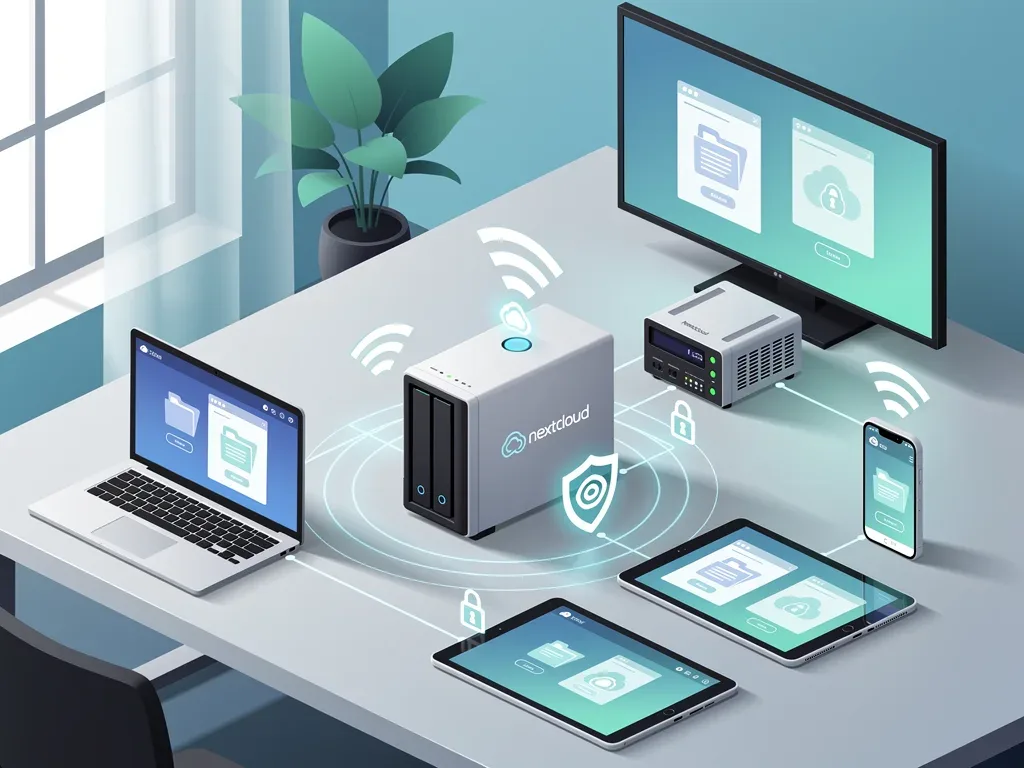
Technical Setup and Maintenance Considerations
Setting up a Nextcloud instance on a NAS involves a few technical steps, but modern NAS devices and Nextcloud's user-friendly interface have made this process increasingly accessible. Many NAS operating systems offer one-click installations for Nextcloud.
While initial setup might require some technical aptitude, ongoing maintenance is generally minimal, involving occasional software updates and hardware checks. The learning curve for managing a self-hosted solution is often less steep than anticipated.
Resources such as online communities, official documentation, and tutorials provide extensive support for users, ensuring that even those with limited IT experience can successfully deploy and manage their Self-Hosted Nextcloud vs Commercial Cloud solution.
Key Steps for Deployment
The process typically begins with selecting a suitable NAS device, followed by installing and configuring the hard drives. Once the NAS operating system is ready, Nextcloud can be deployed.
NAS hardware selection and disk installation.
Installation of the NAS operating system and Nextcloud application.
Network configuration for remote access, including port forwarding and dynamic DNS.
Regular backups of the Nextcloud data and configuration are essential to ensure data integrity and disaster recovery. This proactive approach to data management is a cornerstone of responsible self-hosting.
Scalability and Future-Proofing Your Storage
A significant advantage of a local NAS setup with Nextcloud is its inherent scalability. As your storage needs grow, you can often upgrade hard drives to larger capacities or add more bays to your existing NAS, extending its lifespan and utility.
This contrasts with commercial cloud services where scaling up often means moving to a more expensive tier, sometimes with disproportionately higher costs. A self-hosted solution allows for more granular and cost-effective expansion.
Furthermore, investing in a NAS is an investment in a versatile piece of hardware that can serve multiple functions beyond just Nextcloud, such as media streaming, home automation, or even hosting other applications, future-proofing your digital infrastructure.
Addressing Potential Challenges and Mitigations
While the benefits of Self-Hosted Nextcloud vs Commercial Cloud are compelling, it is important to acknowledge potential challenges. These primarily revolve around initial technical setup, ensuring robust security, and managing internet connectivity for remote access.
Mitigating these challenges involves thorough research, following best practices for network security, and investing in reliable hardware. For instance, using strong passwords, enabling two-factor authentication, and keeping software updated are crucial security measures.
Reliable internet service with adequate upload speeds is also essential for a smooth remote access experience. Users should consider their internet plan's capabilities when planning a self-hosted cloud solution to avoid performance bottlenecks.
Key Point | Brief Description |
|---|---|
Cost Savings | A 4TB NAS pays for itself in ~18 months compared to commercial cloud subscriptions. |
Data Control | Self-hosting provides complete ownership and control over your data. |
Privacy Enhancement | Data remains local, mitigating risks associated with third-party data handling. |
Scalability | Easily expand storage by upgrading drives or adding bays, unlike fixed cloud plans. |
Frequently Asked Questions About Self-Hosted Nextcloud
What is the primary advantage of Self-Hosted Nextcloud vs Commercial Cloud?▼
The main advantage is complete data ownership and control. Unlike commercial cloud services where data resides on third-party servers, self-hosting ensures your files stay on your hardware, enhancing privacy and security while eliminating recurring subscription costs.
How does a 4TB NAS pay for itself in 18 months?▼
By comparing the one-time cost of a 4TB NAS setup (hardware, drives) against the cumulative monthly fees of an equivalent commercial cloud subscription. Over time, the savings from avoiding recurring cloud payments will offset the initial NAS investment, often within 18 months, depending on the cloud plan's cost.
Is technical expertise required to set up Self-Hosted Nextcloud?▼
While some technical understanding is beneficial, modern NAS devices often feature user-friendly interfaces and one-click installers for Nextcloud. Extensive online resources and community support are available, making the setup process manageable for users with varying technical backgrounds.
What are the ongoing costs of a self-hosted NAS?▼
The primary ongoing costs include electricity consumption, which is typically minimal, and potential future hard drive replacements after several years. These are significantly lower and more predictable than continuous commercial cloud subscription fees, further solidifying the financial benefit of Self-Hosted Nextcloud vs Commercial Cloud.
How secure is a self-hosted Nextcloud setup compared to commercial clouds?▼
A properly configured self-hosted Nextcloud can be very secure, often surpassing commercial offerings in terms of privacy due to local data storage. Users control encryption, access, and updates. Implementing strong passwords, two-factor authentication, and regular software updates are crucial for maintaining high security standards.
Impact and Implications
The growing viability of Self-Hosted Nextcloud vs Commercial Cloud marks a significant shift in how individuals and small businesses approach data storage. This trend underscores a broader demand for greater digital autonomy, cost efficiency, and enhanced privacy, moving away from reliance on large tech corporations.
As hardware becomes more affordable and software more user-friendly, the decision to self-host is becoming an increasingly practical and financially sound choice for many, reshaping the landscape of personal and professional data management.