Treasury Direct vs. 4.75% High-Yield Savings: Cash Reserve Allocation
Advertisements
Determining where to park your liquid capital requires weighing tax advantages against instant withdrawal flexibility in today's shifting interest rate environment. Navigating Treasury Direct vs. HYSA allows smart investors to maximize yields on emergency cash while protecting short-term principal balances from market volatility.
Direct federal debt instruments offer exempt state and local tax savings along with backed government safety, whereas high-yield savings accounts provide seamless liquidity for immediate cash needs.
Balancing short-term Treasury bills with high-yielding deposit accounts ensures optimal capital preservation without sacrificing easy access during unexpected financial emergencies.
Optimizing your liquidity strategy guarantees every dollar works efficiently across shifting monetary policy cycles. Here is how to strategically divide your cash reserves between government-backed debt and liquid yield-bearing bank accounts.
The Current Landscape of Cash Reserve Allocation
The financial environment in the United States currently presents a unique set of opportunities and considerations for cash management. With the Federal Reserve’s actions influencing interest rates, both traditional and alternative savings vehicles are offering attractive returns not seen in over a decade.
Investors are seeking options that not only provide competitive yields but also ensure the safety and liquidity of their funds. This renewed focus on cash optimization highlights the importance of understanding the nuances between seemingly similar investment avenues.
Understanding the current economic climate is crucial for making informed decisions about where to park your money. The discussion around Treasury Direct vs. HYSA is more relevant than ever.
Treasury Direct: Government-Backed Security
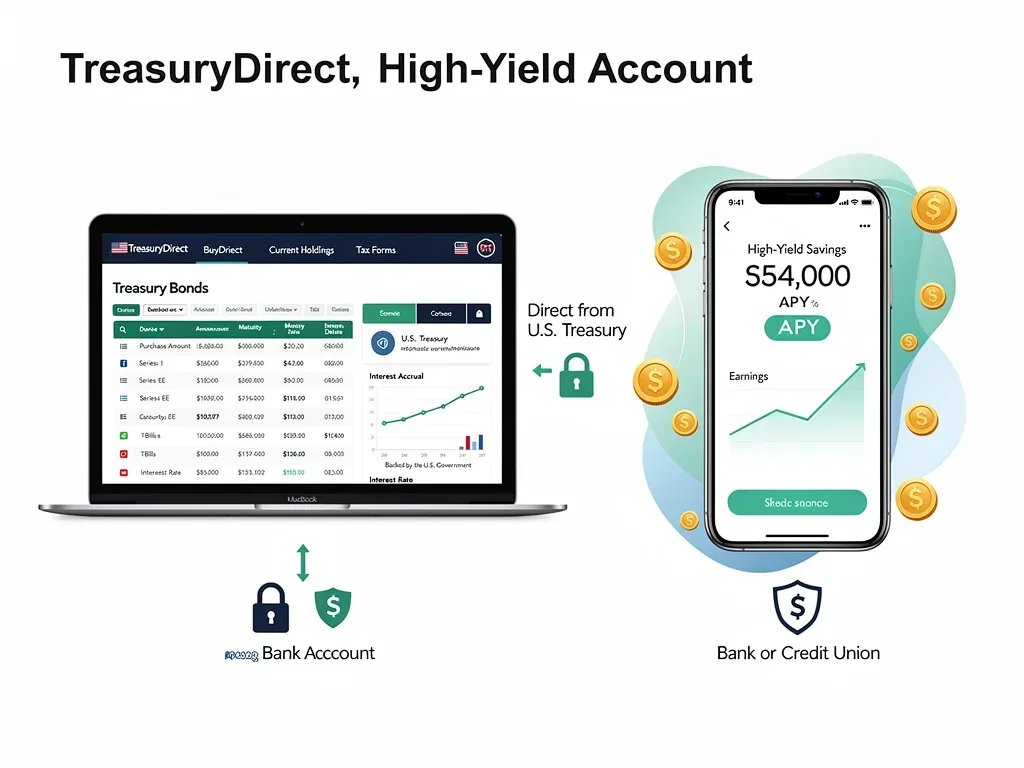
Treasury Direct serves as a direct portal for purchasing U.S. Treasury securities, including Treasury Bills, Notes, Bonds, and I Bonds, directly from the U.S. government. These investments are backed by the full faith and credit of the U.S. government, making them among the safest options available.
The appeal of Treasury Direct lies in its unparalleled security and often competitive yields, especially for short-term T-Bills. Recent auction rates have made these instruments particularly attractive for those looking to secure funds for a defined period.
However, the platform's interface and the mechanics of buying and selling can be less intuitive for some users, requiring a degree of familiarity with government securities.
Direct purchase from the U.S. Treasury, bypassing intermediaries.
Highest level of security, backed by the U.S. government.
Yields often competitive with or exceeding traditional bank offerings.
Tax advantages at the state and local levels.
The process involves setting up an account, linking a bank account, and participating in auctions or purchasing marketable securities. This direct approach ensures that investors receive the full yield without brokerage fees.
High-Yield Savings Accounts: Accessibility and Liquidity
High-Yield Savings Accounts (HYSAs) have emerged as a prominent alternative for cash reserves, offering significantly higher interest rates than traditional savings accounts. Many online banks and financial institutions currently provide APYs around 4.75% or even higher, making them very competitive.
The primary advantages of HYSAs include their ease of access, liquidity, and FDIC insurance coverage up to $250,000 per depositor, per insured bank, for each account ownership category. This combination of yield, accessibility, and insurance makes them a popular choice.
For those prioritizing immediate access to funds and a straightforward banking experience, HYSAs often present a more convenient solution. The growth in online banking has further enhanced their appeal, offering seamless digital management.
When considering Treasury Direct vs. HYSA, the convenience factor of HYSAs often stands out.
Comparing Yields and Interest Rate Dynamics
While both Treasury Direct and HYSAs offer attractive yields, their interest rate dynamics differ. Treasury yields are determined by market forces and government auctions, fluctuating based on economic indicators and Federal Reserve policy. The advertised 4.75% APY for HYSAs is set by individual banks and can change.
For example, a 4-week Treasury Bill might offer a specific yield for its duration, locking in that rate for the investor. In contrast, an HYSA's APY is variable and can be adjusted by the bank at any time, reflecting changes in the broader interest rate environment.
This distinction is critical for investors who prefer predictable returns versus those who value the potential for higher, albeit variable, rates. The decision between Treasury Direct vs. HYSA hinges on these dynamics.
Security and Insurance: What You Need to Know
The security of your principal is a paramount concern when allocating cash reserves. Both Treasury Direct and HYSAs offer robust protections, though through different mechanisms. Understanding these differences is essential for informed decision-making.
Treasury securities are considered virtually risk-free from a credit perspective because they are backed by the full faith and credit of the U.S. government. This means the likelihood of default is extremely low, providing ultimate peace of mind for investors.
HYSAs, on the other hand, are protected by the Federal Deposit Insurance Corporation (FDIC) for up to $250,000 per depositor, per insured bank, for each account ownership category. This federal insurance provides a strong safety net for deposits.
When evaluating Treasury Direct vs. HYSA, both options stand out for their strong security profiles, albeit with distinct backing mechanisms.
Liquidity and Accessibility Considerations
Liquidity refers to how easily and quickly you can access your funds without penalty. This aspect is often a key differentiator between Treasury Direct and HYSAs, influencing investment choices for cash reserves.
HYSAs generally offer high liquidity, allowing depositors to withdraw funds via ATM, online transfers, or checks with relative ease, often without penalties for frequent access. This flexibility makes them ideal for emergency funds or short-term savings goals.
Treasury securities, particularly T-Bills, offer varying degrees of liquidity. While they can be sold on the secondary market before maturity, this process can involve transaction costs and potential price fluctuations. Holding them to maturity guarantees the stated yield.
HYSAs provide immediate access to funds for emergencies.
Treasury Bills offer guaranteed returns if held to maturity.
Selling Treasury securities early might incur market risk.
Consider your need for immediate cash when choosing.
Tax Implications: State, Local, and Federal
Taxation is a significant factor in maximizing net returns from your cash reserves. The tax treatment of interest earned from Treasury securities differs from that of interest earned in HYSAs, which can impact your overall financial strategy.
Interest earned on U.S. Treasury securities is exempt from state and local income taxes, though it is subject to federal income tax. This exemption can be a considerable advantage for residents in states with high income tax rates.
In contrast, interest earned on HYSAs is generally subject to federal, state, and local income taxes. This means that while the headline APY of an HYSA might be attractive, the after-tax yield could be lower than a comparable Treasury investment for some individuals.
Understanding these tax implications is crucial when comparing Treasury Direct vs. HYSA, especially for long-term planning.

Ease of Use and Account Management
The user experience and ease of managing accounts also play a role in deciding where to allocate cash reserves. This often comes down to personal preference and familiarity with digital platforms.
Treasury Direct, while functional, has been criticized for its somewhat dated interface and less intuitive navigation compared to modern banking apps. It requires a learning curve for new users to understand the auction process and manage their holdings.
HYSAs, particularly those offered by online banks, typically boast user-friendly mobile apps and intuitive online platforms. This makes managing deposits, withdrawals, and tracking interest earnings a seamless experience for most users.
For investors prioritizing simplicity and ease of day-to-day management, an HYSA might be more appealing in the Treasury Direct vs. HYSA debate.
Who Benefits Most from Each Option?
Identifying the ideal candidate for each option helps clarify the decision-making process for cash reserve allocation. The suitability of Treasury Direct versus a 4.75% HYSA depends heavily on individual financial goals, risk tolerance, and liquidity needs.
Treasury Direct is often best suited for investors seeking maximum security, state and local tax advantages, and who are comfortable with a slightly less user-friendly interface. It's an excellent choice for those with longer-term cash reserves or specific short-term savings goals where funds can be locked in for a fixed period.
Conversely, a 4.75% HYSA appeals to individuals who prioritize liquidity, ease of access, and a straightforward banking experience. It's ideal for emergency funds, short-term savings goals requiring flexible access, and those who value the convenience of modern online banking.
Ultimately, the best choice in the Treasury Direct vs. HYSA discussion aligns with personal financial priorities.
Diversifying Cash Reserves for Optimal Strategy
Rather than choosing one option exclusively, many financial advisors advocate for a diversified approach to cash reserves. This strategy involves allocating funds across both Treasury Direct and high-yield savings accounts to leverage the benefits of each.
For instance, an investor might keep their emergency fund in an HYSA for immediate access, while allocating longer-term cash reserves or funds earmarked for specific future expenses into Treasury Bills or Notes via Treasury Direct to benefit from tax advantages and fixed yields.
This balanced approach allows for both liquidity and optimized returns, mitigating the limitations of relying solely on one type of account. Diversification is a prudent strategy in the ongoing discussion of Treasury Direct vs. HYSA.
The Role of Economic Outlook in Your Decision
The prevailing economic outlook significantly influences the attractiveness of both Treasury Direct and HYSAs. Understanding current and projected economic trends can help investors anticipate future interest rate movements and adjust their strategies accordingly.
In an environment of rising interest rates, HYSAs can quickly adjust their APYs upwards, potentially offering more competitive rates over time. Treasury Bill yields also tend to rise, but once purchased, the yield is fixed for the duration of the bond.
Conversely, in a declining interest rate environment, HYSA rates may drop, while existing Treasury securities would continue to pay their fixed rate until maturity. This makes the timing of your investment crucial for Treasury Direct purchases.
Monitoring economic forecasts and Federal Reserve announcements is key to navigating the choices in Treasury Direct vs. HYSA.
Key Point | Brief Description |
|---|---|
Security | Treasury Direct offers U.S. government backing; HYSAs have FDIC insurance. |
Liquidity | HYSAs offer easy access; Treasury securities may require secondary market sales. |
Tax Benefits | Treasury interest is state/local tax-exempt; HYSA interest is fully taxable. |
Ease of Use | HYSAs generally provide a more user-friendly digital experience. |
Frequently Asked Questions About Cash Reserves
What is the primary difference in security between Treasury Direct and HYSAs?▼
Treasury Direct securities are backed by the full faith and credit of the U.S. government, offering the highest level of creditworthiness. High-Yield Savings Accounts are insured by the FDIC up to $250,000 per depositor, providing robust protection for deposits at insured banks.
Are interest rates on HYSAs guaranteed like Treasury bonds?▼
No, interest rates on HYSAs are variable and can change at the bank's discretion, reflecting market conditions. Treasury bond yields, once purchased, are fixed for the duration of the bond, providing a guaranteed return if held to maturity.
Which option offers better liquidity for emergency funds?▼
High-Yield Savings Accounts generally offer superior liquidity for emergency funds, allowing for easy and immediate access to cash through transfers, ATMs, or checks. Treasury securities, while marketable, may involve transaction costs or market fluctuations if sold before maturity.
Are there any tax advantages to choosing Treasury Direct?▼
Yes, interest earned on U.S. Treasury securities is exempt from state and local income taxes, though it is subject to federal income tax. Interest from HYSAs is typically subject to federal, state, and local income taxes.
Can I combine both Treasury Direct and HYSAs in my financial strategy?▼
Absolutely. Many financial experts recommend a diversified approach, using HYSAs for readily accessible funds like emergency savings and Treasury Direct for longer-term cash reserves to benefit from specific yields and tax advantages. This strategy balances liquidity with optimized returns.
What this means
The ongoing discussion around Treasury Direct vs. HYSA underscores the importance of a well-informed cash management strategy. Investors must weigh security, liquidity, yield, and tax implications against their individual financial goals.
As economic conditions evolve, staying current on interest rate trends and policy changes will be crucial for optimizing cash reserves.