Configuring Multi-Gigabit Home Networks: Wi-Fi 7 Router Settings for 4.8 Gbps in 2026
Advertisements
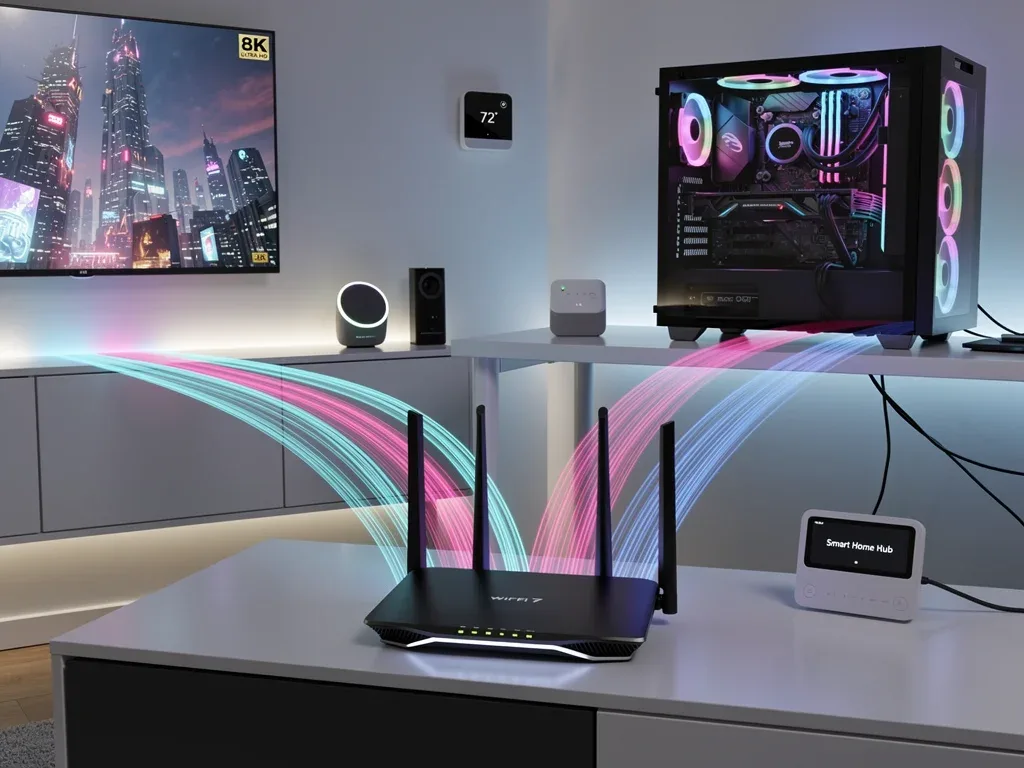
Unlocking ultra-fast throughput across your living space no longer requires a degree in network engineering. Building optimized Multi-Gigabit Home Networks allows you to break past traditional speed bottlenecks and tap into blazing 4.8 Gbps wireless performance this year.
Next-generation wireless hardware alone won't guarantee peak connectivity. Unlocking these ultra-broadband capabilities demands tweaking specific Wi-Fi 7 features, including 320 MHz channels, Multi-Link Operation, and automated channel allocation across high-frequency bands.
Ready to eliminate lag and maximize your fiber infrastructure? Here is how to fine-tune your wireless router settings for flawless high-speed throughput.
The Dawn of Wi-Fi 7: Redefining Home Network Performance
The arrival of Wi-Fi 7, also known as 802.11be or Extremely High Throughput (EHT), marks a significant leap in wireless technology. It promises unprecedented speeds and efficiency, fundamentally transforming how we interact with our digital environments.
For homeowners and tech enthusiasts, the prospect of achieving multi-gigabit speeds, specifically 4.8 Gbps and beyond, is no longer a distant dream but a tangible reality within reach by 2026.
This new standard is designed to handle the growing demands of bandwidth-intensive applications, from 8K video streaming and VR/AR experiences to cloud gaming and extensive smart home ecosystems.
Understanding and correctly applying Wi-Fi 7 router settings will be paramount to unlocking this potential, ensuring your home network is not just fast, but also stable and future-proof. The focus is on optimizing every aspect of the wireless connection for peak performance.
Key Technologies Driving Wi-Fi 7 Throughput
Wi-Fi 7 introduces several groundbreaking technologies that collectively enable its remarkable speed and efficiency. These innovations are critical for anyone looking to maximize their multi-gigabit home network experience.
Multi-Link Operation (MLO) allows devices to send and receive data across different frequency bands and channels simultaneously, effectively combining their bandwidth for a single connection. This dramatically boosts throughput and reduces latency, a cornerstone for achieving 4.8 Gbps.
Another pivotal feature is 320 MHz channel width, doubling the capacity of Wi-Fi 6E's 160 MHz channels. This wider channel, primarily available in the 6 GHz band, provides a massive data pipeline, essential for the high throughput targets of Wi-Fi 7 router settings.
Multi-Link Operation (MLO) Explained
MLO is perhaps the most revolutionary aspect of Wi-Fi 7, enabling devices to utilize multiple frequency bands (2.4 GHz, 5 GHz, and 6 GHz) concurrently. This isn't just about band steering; it's about active aggregation of bandwidth for a single data stream.
This capability offers significant benefits, including enhanced reliability and reduced latency, as data can be rerouted if one link experiences interference or congestion. Configuring Multi-Gigabit Home Networks will heavily rely on optimizing MLO.
320 MHz Channels and 4096-QAM
320 MHz Channel Width: This wider channel is exclusive to the 6 GHz band and provides unparalleled capacity, minimizing congestion in dense network environments.
4096-QAM Modulation: Quadrupling the data density per signal compared to Wi-Fi 6's 1024-QAM, allowing more bits to be transmitted per hertz.
Preamble Puncturing: Enhances spectral efficiency by allowing an access point to 'puncture' or exclude narrow interference channels within a wider channel, maintaining high throughput.
Enhanced OFDMA: Improves efficiency and reduces latency by allowing multiple users to share channels simultaneously, optimizing resource allocation.
Optimizing Wi-Fi 7 Router Settings for Maximum Throughput
Achieving the promised 4.8 Gbps throughput requires careful optimization of your Wi-Fi 7 router settings. It's not merely about having the latest hardware; it's about configuring it intelligently to suit your specific home network environment.
The first step involves ensuring your router is running the latest firmware, as manufacturers continually release updates that improve performance and introduce new features. Regular firmware updates are crucial for security and optimal operation.
Beyond firmware, specific settings related to channel selection, bandwidth, and security protocols play a pivotal role in maximizing speed and minimizing interference. These configurations are the backbone of a high-performing multi-gigabit network.
Channel Selection and Bandwidth Configuration
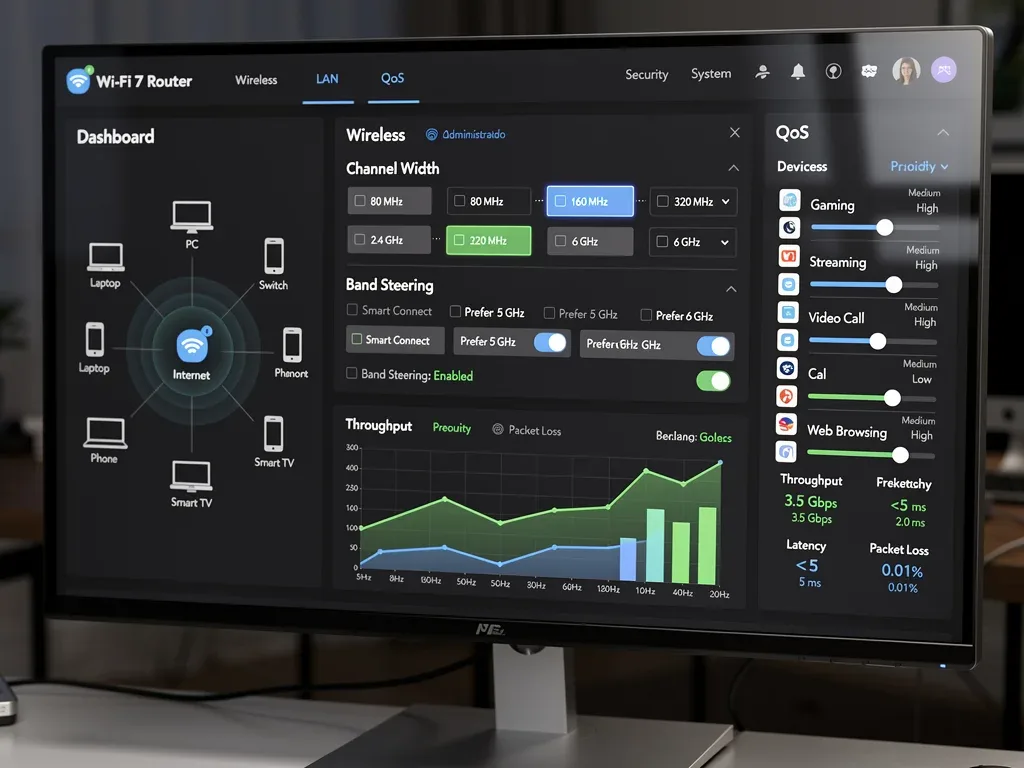
For optimal performance, prioritize the 6 GHz band due to its wider 320 MHz channels and less interference. Manually selecting channels within this band that are less congested can significantly boost your throughput. Auto-selection can sometimes pick suboptimal channels.
Ensure that your Wi-Fi 7 router settings are configured to utilize the maximum channel width of 320 MHz where available. This is a critical factor for achieving multi-gigabit speeds. In areas with high interference, reducing channel width slightly might provide more stability, but for raw speed, wider is better.
Quality of Service (QoS) and Traffic Prioritization
Intelligent QoS: Configure QoS settings to prioritize bandwidth for critical applications like gaming, video conferencing, or 8K streaming.
Traffic Prioritization: Ensure that devices requiring high throughput and low latency, such as gaming consoles or VR headsets, receive preferential treatment.
Band Steering: Enable band steering to automatically direct devices to the least congested and most performant band (e.g., 6 GHz for Wi-Fi 7 devices).
WPA3 Security: Implement WPA3 for robust network security, which also contributes to overall network efficiency and trust.
The Role of Multi-Gigabit Ethernet Ports
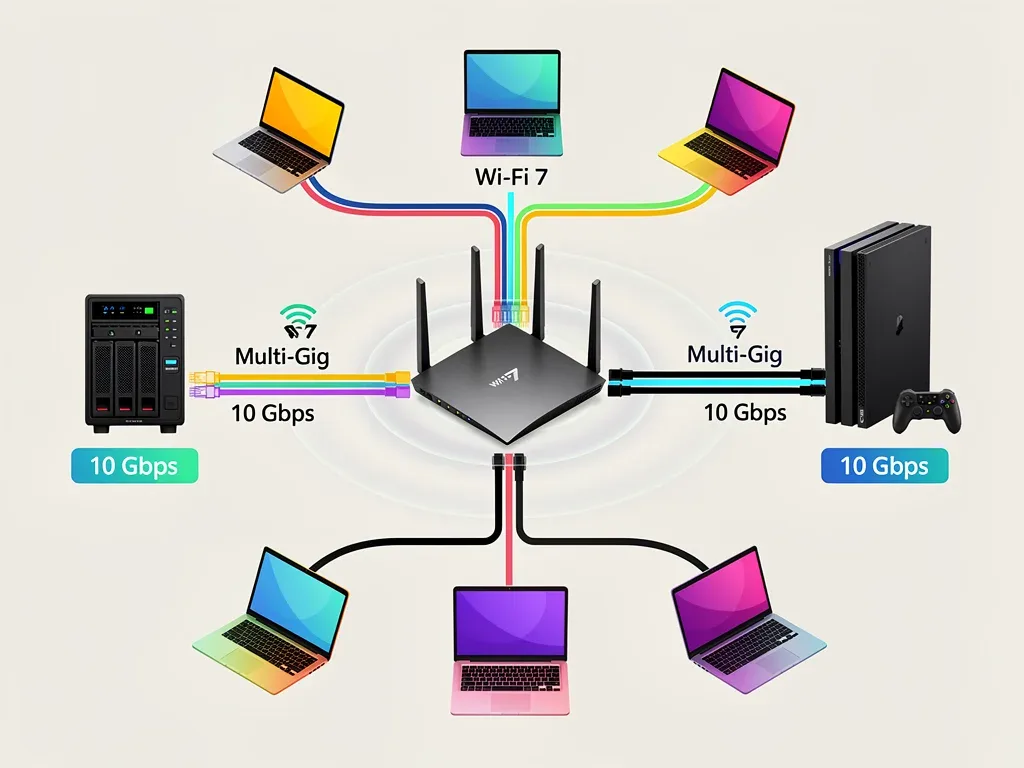
While wireless speeds are the highlight of Wi-Fi 7, the importance of multi-gigabit Ethernet ports on your router cannot be overstated. These ports are essential for connecting wired devices at speeds that match or even exceed the wireless capabilities.
Many Wi-Fi 7 routers come equipped with 2.5 GbE or even 10 GbE WAN and LAN ports. These ports are crucial for ensuring that your internet service provider's multi-gigabit connection can be fully utilized and distributed across your network.
Without adequate wired backhaul, even the most optimized Wi-Fi 7 router settings will be bottlenecked, preventing you from experiencing true multi-gigabit speeds throughout your home network. It's a holistic approach to high-speed connectivity.
Connecting High-Bandwidth Devices
Devices like Network Attached Storage (NAS), high-end gaming PCs, and even certain smart home hubs benefit immensely from a direct multi-gigabit wired connection to the router. This offloads traffic from the wireless spectrum, further enhancing overall network performance.
When configuring Multi-Gigabit Home Networks, consider upgrading your network infrastructure, including Ethernet cables (Cat6a or higher) and switches, to support these higher speeds. A chain is only as strong as its weakest link.
Future-Proofing Your Home Network for 2026 and Beyond
Investing in Wi-Fi 7 router settings today is a significant step towards future-proofing your home network. As more devices become Wi-Fi 7 enabled and bandwidth demands continue to escalate, having a network capable of handling these loads will be crucial.
The capabilities of Wi-Fi 7 extend beyond just raw speed; they also encompass improved efficiency, lower latency, and better handling of crowded network environments. These attributes will become increasingly important as smart homes become more sophisticated and data-intensive.
By diligently configuring your Wi-Fi 7 router settings and understanding the underlying technologies, you are not just optimizing for today, but preparing for the evolving landscape of digital connectivity in the years to come.
Emerging Applications and Device Compatibility
As 2026 approaches, expect a proliferation of devices that fully leverage Wi-Fi 7's capabilities, from advanced VR/AR headsets to intelligent robotics and ultra-high-definition streaming services. Ensuring your router settings are optimal will be key to their seamless operation.
Compatibility with older Wi-Fi standards (backward compatibility) is also a consideration. While Wi-Fi 7 routers will support older devices, the full benefit of multi-gigabit speeds will only be realized with Wi-Fi 7 enabled clients. This requires a gradual upgrade path for your devices.
Addressing Common Challenges in Multi-Gigabit Networks
While Wi-Fi 7 offers immense potential, implementing and maintaining a multi-gigabit home network can present certain challenges. Proactive troubleshooting and understanding common pitfalls are essential for a smooth experience.
Interference, even in the less congested 6 GHz band, can still occur from other wireless devices or even structural elements within your home. Proper router placement and channel optimization in the Wi-Fi 7 router settings are vital to mitigate these issues.
Ensuring all components of your network, from the modem to network adapters in your devices, are capable of multi-gigabit speeds is also critical. A single slower component can bottleneck the entire system, preventing you from reaching 4.8 Gbps.
Troubleshooting and Performance Monitoring
Router Placement: Position your router centrally and away from obstructions to maximize signal coverage and strength across your home.
Interference Mitigation: Use spectrum analysis tools, if available in your router's interface, to identify and avoid congested channels.
Firmware Updates: Regularly check for and install firmware updates from your router manufacturer to ensure optimal performance and security.
Network Monitoring: Utilize your router's built-in monitoring tools or third-party applications to track throughput, latency, and connected devices.
The Impact of Wi-Fi 7 on Smart Home Ecosystems
The enhanced capabilities of Wi-Fi 7 extend significant benefits to smart home ecosystems, enabling more responsive and reliable operation for a multitude of connected devices. This is particularly relevant as smart homes become more integrated and data-rich.
With more devices communicating simultaneously, Wi-Fi 7's improved efficiency, particularly through features like MLO and OFDMA, prevents network congestion. This ensures that critical smart home functions, such as security cameras or automated systems, operate without lag.
Configuring Multi-Gigabit Home Networks will directly impact the responsiveness and reliability of these complex smart home setups. Low latency is paramount for seamless automation and real-time control.
Enhanced Reliability for IoT Devices
The ability of Wi-Fi 7 to handle a higher density of devices with greater efficiency means that even a home with hundreds of smart gadgets will experience robust connectivity. This eliminates dropped connections and delays that can plague older Wi-Fi standards.
For applications like smart surveillance or advanced home automation, the consistent 4.8 Gbps throughput provided by optimized Wi-Fi 7 router settings ensures that data streams are delivered without interruption, leading to a more secure and responsive smart home environment.
Security Considerations for Advanced Wi-Fi 7 Networks
As network speeds and capabilities advance, so too must security measures. Wi-Fi 7 routers, while offering cutting-edge performance, also come with enhanced security protocols that users should leverage to protect their multi-gigabit home networks.
WPA3, the latest Wi-Fi security standard, is a mandatory feature for Wi-Fi 7. It provides stronger encryption and improved protection against brute-force attacks compared to its predecessor, WPA2. Enabling WPA3 in your Wi-Fi 7 router settings is non-negotiable for robust security.
Beyond WPA3, other security practices, such as strong, unique passwords for your network and router administration interface, are vital. Regularly reviewing connected devices and enabling guest networks for visitors further enhances network security, protecting your 4.8 Gbps connection.
Implementing Robust Security Protocols
Regularly updating your router's firmware not only improves performance but also patches security vulnerabilities. Manufacturers frequently release updates to address newly discovered threats, making it a critical aspect of maintaining a secure Wi-Fi 7 network.
Consider enabling network segmentation if your router supports it, creating separate networks for IoT devices or guests. This isolates potential threats and limits their access to your primary network, a key strategy when configuring Multi-Gigabit Home Networks.
Key Point | Brief Description |
|---|---|
Wi-Fi 7 Core Technologies | MLO, 320 MHz channels, and 4096-QAM are fundamental for 4.8 Gbps throughput. |
Router Settings Optimization | Prioritize 6 GHz band, 320 MHz channel width, and intelligent QoS for peak performance. |
Multi-Gigabit Ethernet | Essential for wired device connectivity and maximizing ISP multi-gigabit connections. |
Future-Proofing & Security | Wi-Fi 7 router settings ensure readiness for 2026 demands and mandate WPA3 security. |
Frequently Asked Questions About Wi-Fi 7 Router Settings
What is the primary benefit of Wi-Fi 7 for home users?▼
The primary benefit of Wi-Fi 7 for home users is significantly higher throughput, enabling multi-gigabit speeds up to 4.8 Gbps and beyond. This translates to faster downloads, smoother 8K streaming, and lag-free gaming, especially with multiple demanding devices operating simultaneously on the network.
How do I ensure my devices can utilize Wi-Fi 7 speeds?▼
To fully utilize Wi-Fi 7 speeds, your devices must be Wi-Fi 7 compatible. This includes laptops, smartphones, and other network adapters. Even with optimal Wi-Fi 7 router settings, older Wi-Fi 6E or Wi-Fi 6 devices will operate at their respective maximum speeds, not the full Wi-Fi 7 potential.
Is the 6 GHz band essential for achieving 4.8 Gbps with Wi-Fi 7?▼
Yes, the 6 GHz band is crucial for achieving the highest Wi-Fi 7 speeds, particularly the 4.8 Gbps throughput. It offers wider 320 MHz channels and less interference compared to the 2.4 GHz and 5 GHz bands, providing the necessary bandwidth for multi-gigabit performance.
What role does Multi-Link Operation (MLO) play in Wi-Fi 7 performance?▼
MLO is a cornerstone of Wi-Fi 7 performance, allowing devices to use multiple frequency bands and channels concurrently. This innovative feature significantly boosts aggregated throughput, reduces latency, and enhances network reliability by dynamically switching or combining links, directly impacting the effective Wi-Fi 7 router settings.
What security measures should I prioritize for my Wi-Fi 7 network?▼
Prioritize WPA3 encryption, which is mandatory for Wi-Fi 7, for robust security against modern threats. Additionally, ensure your router firmware is always updated, use strong, unique passwords, and consider network segmentation for IoT devices to enhance overall network protection.
Looking Ahead: The Evolution of Home Connectivity
The trajectory of home networking is clearly set towards greater speed, efficiency, and intelligence, with Wi-Fi 7 serving as a pivotal enabler. As we move towards 2026, the widespread adoption of multi-gigabit networks and devices will transform digital experiences.
The continued refinement of Wi-Fi 7 router settings and the emergence of even more sophisticated network management tools will empower users to fully harness these advanced capabilities. This evolution promises a seamless, high-performance digital lifestyle, adapting to future demands.
Monitoring industry developments, understanding new Wi-Fi 7 router settings, and continually optimizing your setup will be key to staying at the forefront of home connectivity, ensuring your network is ready for whatever the future brings.