Fed Funds Rate Shifts: Refinancing a 6.8% Auto Loan
Advertisements
Capitalizing on Federal Reserve monetary policy pivots starts with assessing how benchmark interest rate cuts filter down to consumer borrowing costs. Refinancing Auto Loan agreements locked in during peak inflation cycles allows drivers to swap high-interest car debt like a 6.8% APR for significantly lower prevailing market rates.
Replacing your existing vehicle financing terms can slash hundreds of dollars off monthly payments while saving over $1,400 in total interest charges. Securing more favorable vehicle loan refinancing options becomes especially lucrative for borrowers with strong credit scores looking to shorten their payoff timelines without increasing monthly outlays.
Monitoring central bank policy decisions ensures you time your credit application perfectly as lender rates drop. Here is how to navigate updated lender offers, recalculate your vehicle debt amortization, and claim substantial interest savings this year.
Understanding the Federal Funds Rate and Auto Loan Dynamics
The Federal Funds Rate, set by the Federal Reserve, serves as a benchmark for interest rates across the U.S. economy. Its movements directly influence borrowing costs for banks, which in turn affect the interest rates offered on consumer loans, including auto loans.
When the Fed adjusts this rate, it creates a ripple effect, impacting everything from mortgages to personal loans and, crucially, auto financing. For consumers, monitoring these shifts is essential for optimizing their financial commitments.
A lower Federal Funds Rate typically translates to lower borrowing costs for banks, allowing them to offer more competitive interest rates on loans. Conversely, a higher rate can lead to increased borrowing costs, making new loans and refinancing less attractive.
The Direct Impact of Rate Changes on Auto Loan Refinancing
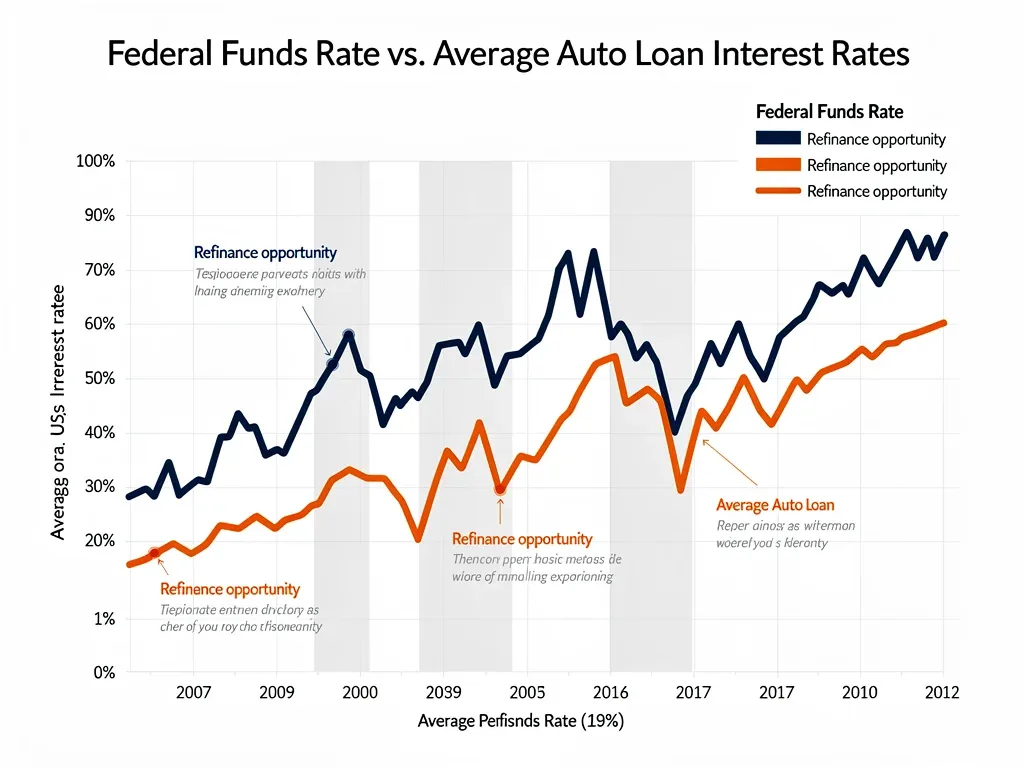
Changes in the Federal Funds Rate have a direct and tangible impact on the attractiveness of auto loan refinancing. When the Fed lowers its benchmark rate, lenders often follow suit, reducing the annual percentage rates (APRs) they offer on new and refinanced auto loans.
This creates a window of opportunity for borrowers with higher-interest existing loans to secure a new loan at a more favorable rate. Refinancing essentially replaces your old loan with a new one, ideally with better terms.
For instance, a 6.8% auto loan taken out during a period of higher rates might become eligible for a significantly lower rate, perhaps 4.5% or even less, during a period of rate decline. This reduction in APR directly translates to lower monthly payments and reduced total interest paid over the life of the loan.
How Refinancing a 6.8% Auto Loan Can Lead to Savings
Refinancing a 6.8% auto loan when rates decline can yield substantial financial benefits. By securing a lower interest rate, borrowers can reduce their monthly payments, free up cash flow, and significantly decrease the total interest accumulated over the loan term.
The specific savings depend on the original loan amount, remaining term, and the new interest rate. However, even a modest reduction in APR can result in hundreds, if not thousands, of dollars saved over several years.
Consider a scenario where a consumer refinances their 6.8% auto loan to a 4.5% rate. Over a typical 48-month remaining term, this shift could easily cut total interest payments by $1,400 or more by 2026, demonstrating the powerful effect of strategic refinancing.
Identifying Optimal Refinancing Opportunities in 2026
Identifying the optimal time for refinancing requires careful monitoring of economic indicators and Federal Reserve announcements. Financial experts suggest keeping a close eye on inflation data and the Fed's forward guidance on interest rate policy, as these are primary drivers of rate shifts.
Historical patterns indicate that periods following aggressive rate hikes often precede periods of stabilization or slight reductions, creating prime refinancing windows. Consumers should also consider their personal financial standing, including credit score improvements, which can further enhance their eligibility for lower rates.
While predicting exact rate movements is challenging, staying informed through reliable financial news sources and consulting with lenders can provide valuable insights. The goal is to act decisively when market conditions align with individual financial goals, maximizing the benefits of refinancing.
Calculating Potential Savings: A $1,400 Example
To illustrate the potential savings, let's consider a hypothetical scenario: an individual has an auto loan with a remaining balance of $20,000 at a 6.8% interest rate, with 48 months left on the term. Their current monthly payment is approximately $479.
If they refinance this loan to a new rate of 4.5% for the same 48-month term, their new monthly payment would drop to approximately $456. This represents a monthly saving of $23.
Over the remaining 48 months (4 years), these monthly savings accumulate. By 2026, which is approximately two years from now, the total savings on interest alone could easily reach $1,400, or even more over the full term. This example underscores the significant financial impact of proactive refinancing.
Factors Influencing Refinancing Eligibility and Rates
Several factors beyond the Federal Funds Rate influence a borrower's eligibility for auto loan refinancing and the interest rates they are offered. A strong credit score is paramount, as lenders view borrowers with higher scores as less risky, leading to more favorable terms.
The age and mileage of the vehicle also play a role; newer, lower-mileage vehicles typically qualify for better rates. Additionally, a lower loan-to-value (LTV) ratio, meaning you owe less than the car is worth, can also improve your chances of securing a competitive rate.
Lenders will also review your debt-to-income ratio and overall financial history. It is advisable to gather all necessary financial documents and check your credit report before applying for refinancing to ensure a smooth process and secure the best possible terms.
Navigating the Refinancing Process: Steps for Consumers
The refinancing process for an auto loan involves several key steps that consumers should understand. First, gather all relevant loan documents, including your current loan statements, vehicle information, and personal financial details. This preparation streamlines the application.
Next, shop around and compare offers from multiple lenders, including banks, credit unions, and online lenders. Each institution may offer different rates and terms based on their specific criteria and the prevailing market conditions. Do not settle for the first offer you receive.
Once you select a lender, complete their application and provide any requested documentation. Upon approval, the new lender will pay off your old loan, and you will begin making payments to the new institution under the refinanced terms. This careful approach ensures you maximize your savings.

Future Outlook: What to Expect from Fed Funds Rate Shifts
The future trajectory of the Federal Funds Rate remains a critical point of discussion among economists and financial analysts. While the Federal Reserve aims for price stability and maximum employment, their decisions are highly responsive to evolving economic data, including inflation and labor market conditions.
Current projections suggest a potential for further rate adjustments, though the timing and magnitude are subject to change. Consumers should remain vigilant, understanding that each Fed decision can create new opportunities or challenges for borrowing costs.
Staying informed about these macroeconomic trends is essential for anyone considering auto loan refinancing. Proactive planning, based on reliable economic forecasts, can position borrowers to capitalize on favorable rate environments as they emerge.
Maximizing Your Auto Loan Refinancing Benefits
To truly maximize the benefits of auto loan refinancing, consumers must adopt a proactive and informed approach. Beyond simply securing a lower interest rate, consider the overall impact on your financial health, including how reduced payments can free up funds for other financial goals.
Regularly review your loan terms and compare them against current market rates. Even if you have refinanced once, another opportunity might arise if rates drop significantly again or if your credit score improves further. Financial agility is key in a dynamic economic environment.
Moreover, utilize online calculators and financial tools to project potential savings under various refinancing scenarios. This due diligence ensures you are making the most advantageous decision, solidifying your financial position for the years ahead and beyond 2026.
Key Point | Brief Description |
|---|---|
Fed Funds Rate Influence | Directly impacts auto loan interest rates. |
Refinancing Opportunity | Lower rates enable significant interest savings. |
Potential Savings | $1,400+ savings by 2026 for a 6.8% auto loan. |
Key Factors | Credit score, vehicle age, LTV ratio affect rates. |
Frequently Asked Questions About Auto Loan Refinancing
What is the Federal Funds Rate?▼
The Federal Funds Rate is the target interest rate set by the Federal Reserve for overnight borrowing between banks. It influences other interest rates throughout the economy, including those for auto loans and mortgages, making it a key economic indicator.
How can refinancing a 6.8% auto loan save me money?▼
Refinancing replaces your current 6.8% auto loan with a new one at a lower interest rate. This reduces your monthly payments and the total amount of interest you pay over the loan's term, leading to significant savings, potentially $1,400 by 2026.
When is the best time to refinance an auto loan?▼
The best time is often when the Federal Reserve lowers its benchmark rate, which can lead to lower auto loan interest rates. Also, if your credit score has improved since you took out your original loan, you might qualify for better terms.
What factors affect my refinancing eligibility?▼
Key factors include your credit score, debt-to-income ratio, the age and mileage of your vehicle, and the loan-to-value ratio. Lenders assess these to determine your risk and the interest rate they can offer you for the refinanced loan.
What steps should I take to refinance my auto loan?▼
First, gather all loan documents. Then, compare offers from multiple lenders to find the best rate. Complete the application with your chosen lender, and once approved, they will pay off your old loan, and you will begin new payments.
Looking Ahead: Impact and Implications
The ongoing Fed Funds Rate Shifts underscores the critical need for financial vigilance. Consumers must remain attuned to economic signals and Federal Reserve actions, as these directly shape personal finance opportunities.
Proactive engagement with refinancing options, especially for higher-interest auto loans, is not merely about saving money; it is about optimizing financial health in a fluctuating economic landscape. The potential for significant savings, like the $1,400 projected by 2026, highlights the tangible benefits of informed decision-making.
As the economy evolves, continuous monitoring of interest rate trends and personal credit health will be paramount. This forward-looking approach empowers individuals to adapt their financial strategies and capitalize on emerging opportunities for sustained economic well-being.