Upgrade to Wi-Fi 7 in 2026: Cut Latency 60% with MLO
Advertisements
Is lag slowing down your gaming sessions, 8K streaming, or smart home automation? Transitioning to Wi-Fi 7 is no longer just about raw bandwidth, it is a fundamental shift toward near-zero delay for hyper-connected households.
At the core of this next-generation wireless architecture is Multi-Link Operation, a technology that lets devices simultaneously transmit across multiple frequency bands. By routing traffic over 2.4 GHz, 5 GHz, and 6 GHz channels at once, this mechanism slashes latency by up to 60% while eliminating network congestion.
If you are ready to future-proof your home network against buffering and dropped signals, upgrading your hardware delivers immediate performance gains. Here is how to implement this advanced routing standard and unlock reliable, ultra-responsive wireless connectivity.
Understanding Wi-Fi 7: The Next Generation of Wireless
Wi-Fi 7 represents a monumental leap forward in wireless communication, building upon the foundations laid by Wi-Fi 6 and Wi-Fi 6E. It’s not merely about faster speeds, though it certainly delivers on that front, but also about enhancing the overall efficiency and reliability of wireless connections in increasingly crowded environments.
The standard introduces several key technologies designed to improve throughput and reduce latency, addressing the bottlenecks that plague modern home networks.
As devices proliferate and applications become more demanding, the need for a more robust and intelligent Wi-Fi standard becomes paramount, making the upgrade Wi-Fi 7 conversation timely.
One of the most significant advancements is the introduction of Multi-Link Operation (MLO), a feature that allows devices to simultaneously transmit and receive data across multiple frequency bands. This capability is central to Wi-Fi 7's promise of significantly reduced latency and improved network resilience, making it a game-changer for critical applications.
Key Innovations Driving Wi-Fi 7 Performance
Wi-Fi 7 introduces several core enhancements beyond just MLO that collectively contribute to its superior performance. These innovations are designed to work in concert, creating a more robust and efficient wireless ecosystem for the modern home.
Larger channel widths, up to 320 MHz in the 6 GHz band, allow for much higher data throughput. This wider highway for data means more information can be transmitted simultaneously, directly contributing to faster download and upload speeds, which is a key benefit when you upgrade Wi-Fi 7.
320 MHz Channel Widths: Doubling the capacity of Wi-Fi 6E in the 6 GHz band.
4096-QAM Modulation: Allowing more data to be packed into each signal for increased throughput.
Multi-RU Puncturing: More efficient use of spectrum by allowing channels to be used even when parts are occupied.
These technical advancements lay the groundwork for a truly next-generation wireless experience. The combination of increased bandwidth, more efficient data encoding, and smarter spectrum utilization means that when you upgrade Wi-Fi 7, you are investing in a network capable of handling the most demanding tasks.
The Power of Multi-Link Operation (MLO) in Wi-Fi 7
Multi-Link Operation (MLO) stands out as the most revolutionary feature of Wi-Fi 7, directly addressing the issue of network latency and reliability. Unlike previous Wi-Fi standards where devices typically communicated over a single frequency band at a time, MLO enables simultaneous data transmission across multiple bands.
This capability fundamentally changes how devices interact with the access point, providing multiple pathways for data to travel. By leveraging the 2.4 GHz, 5 GHz, and 6 GHz bands concurrently, MLO offers unprecedented flexibility and resilience, which is a core reason to upgrade Wi-Fi 7.
The immediate benefit of MLO is a significant reduction in latency. If one band experiences interference or congestion, data can seamlessly shift or be simultaneously sent over another, ensuring a consistent and low-latency connection. This is particularly crucial for real-time applications like online gaming, virtual reality, and video conferencing, where even milliseconds of delay can degrade the user experience.
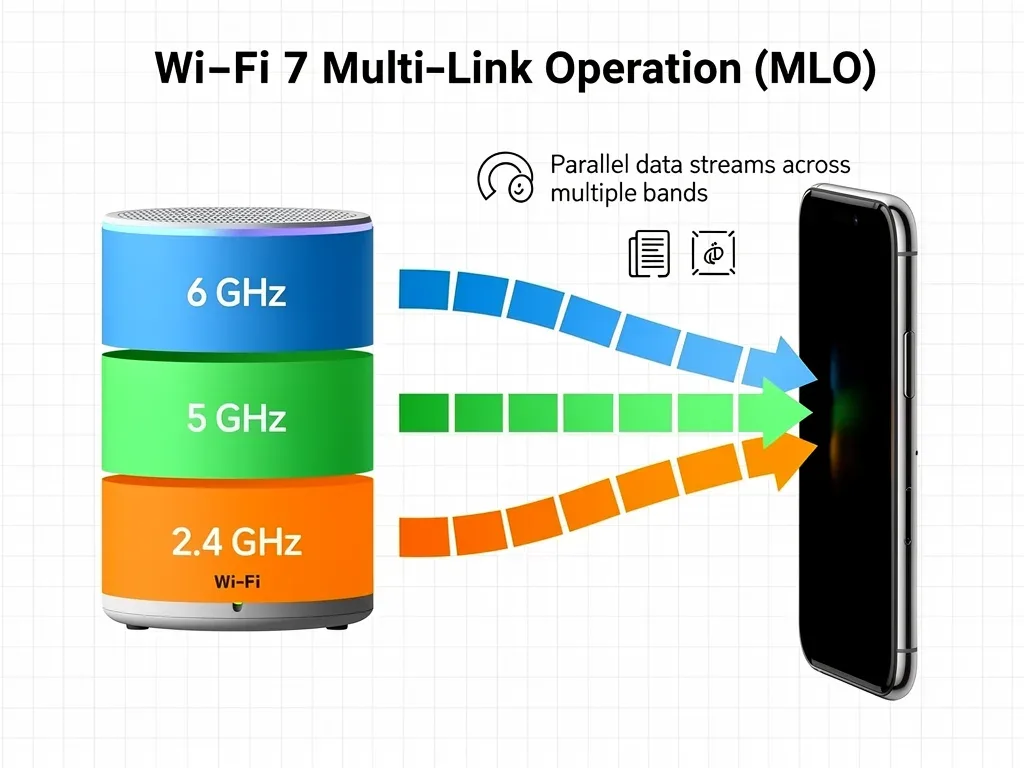
How MLO Cuts Latency by 60%
The 60% latency reduction often cited for Wi-Fi 7, especially through MLO, is achieved by several mechanisms working in tandem. The ability to aggregate bandwidth from different bands means that data packets can reach their destination faster by utilizing multiple routes.
Furthermore, MLO introduces dynamic link switching. If a particular band becomes congested or experiences high interference, the Wi-Fi 7 client and access point can instantly switch or re-route traffic to a less congested band without interrupting the connection. This adaptive capability ensures that the most optimal path is always used, minimizing delays.
Band Aggregation: Combining bandwidth from 2.4 GHz, 5 GHz, and 6 GHz for higher throughput and lower latency.
Dynamic Link Switching: Seamlessly shifting traffic to the least congested band in real-time.
Enhanced Reliability: Redundancy in data transmission paths reduces packet loss and retransmissions.
The cumulative effect of these MLO functionalities is a drastically more responsive and reliable wireless connection. For applications where every millisecond counts, the ability to upgrade Wi-Fi 7 with MLO will provide a distinct advantage, revolutionizing the perception of wireless performance.
Preparing Your Home for a Wi-Fi 7 Upgrade in 2026
The transition to Wi-Fi 7 in 2026 will require more than just purchasing a new router; it involves a holistic approach to your home network infrastructure. Planning ahead can ensure a smooth and effective upgrade, allowing you to fully leverage the benefits of this advanced technology.
The first step in preparing for a Wi-Fi 7 upgrade is to assess your current network setup. This includes evaluating your internet service provider (ISP) plan, as well as the existing cabling within your home. A high-speed internet connection is essential to prevent bottlenecks, even with the most advanced Wi-Fi technology.
Consider the placement of your router and the layout of your home. Wi-Fi signals can be attenuated by walls and other obstructions, so optimizing router placement will be crucial for achieving optimal coverage and performance with your new Wi-Fi 7 system. Proper planning is key to maximize your upgrade Wi-Fi 7 investment.
Essential Hardware for Wi-Fi 7
To experience the full potential of Wi-Fi 7, you will need compatible hardware for both your access point (router) and your client devices. As 2026 approaches, more Wi-Fi 7 certified devices will become available on the market.
A Wi-Fi 7 router or mesh system will be the cornerstone of your upgraded network. These devices will feature the necessary chipsets and antennas to support MLO, 320 MHz channels, and 4096-QAM. Look for models from reputable manufacturers that explicitly state Wi-Fi 7 (802.11be) compatibility.
Wi-Fi 7 Compatible Router/Mesh System: Essential for broadcasting the new standard.
Wi-Fi 7 Client Devices: Smartphones, laptops, smart TVs, and other gadgets with Wi-Fi 7 adapters.
Multi-Gigabit Ethernet Ports: To support the high wired speeds that Wi-Fi 7 can deliver.
It's important to note that while Wi-Fi 7 is backward compatible with older Wi-Fi standards, you will only achieve the full benefits, such as the significant latency reduction, when both your router and client devices support Wi-Fi 7. This synchronized upgrade is fundamental to fully embrace Wi-Fi 7.
The User Experience: What to Expect After You Upgrade Wi-Fi 7
Upgrading to Wi-Fi 7 is not just a technical specification change; it promises a tangible improvement in daily digital interactions. The enhanced capabilities of Wi-Fi 7, particularly through MLO, will translate into a noticeably smoother and more responsive online experience across all connected devices.
For gamers, the reduction in latency by up to 60% means near-instantaneous reactions in online multiplayer games, eliminating frustrating lag spikes. This translates to a more competitive edge and a far more immersive gaming session, making the upgrade Wi-Fi 7 a must-have for serious players.
Content creators and streamers will benefit from faster upload speeds and more stable connections, allowing for high-quality live broadcasts and rapid file transfers. Even basic tasks like web browsing and video calls will feel snappier and more reliable, especially in busy households with numerous devices vying for bandwidth.

Real-World Impact on Daily Activities
The impact of Wi-Fi 7 extends beyond just raw speed; it's about creating a consistently high-performance network that can handle the demands of modern digital life without compromise. From smart homes to virtual reality, the benefits are far-reaching.
Smart home devices, which often rely on stable, low-latency connections for optimal performance, will see improved responsiveness and reliability. Imagine smart lights reacting instantly, security cameras streaming without stutter, and voice assistants responding with minimal delay. This seamless integration is a core promise when you upgrade Wi-Fi 7.
Virtual and augmented reality applications, which are notoriously sensitive to latency, will become more immersive and less prone to motion sickness. The ability of Wi-Fi 7 to deliver consistent, low-latency data streams is crucial for these emerging technologies to reach their full potential, making the upgrade Wi-Fi 7 pivotal.
Challenges and Considerations for Wi-Fi 7 Adoption
While the benefits of Wi-Fi 7 are compelling, its widespread adoption will not be without challenges. Consumers and manufacturers alike will need to navigate several factors to ensure a smooth transition and maximize the potential of this new standard.
One primary consideration is the cost of new hardware. Early Wi-Fi 7 routers and client devices are expected to be premium-priced, which may deter some early adopters. As with any new technology, prices tend to decrease as production scales and competition increases, but initial investment will be a factor when you upgrade Wi-Fi 7.
Another challenge involves spectrum availability and regulation. While the 6 GHz band offers significant advantages, its full utilization depends on regulatory approvals in various regions. Ensuring that all bands can be fully leveraged for MLO is crucial for Wi-Fi 7 to deliver on its promises.
Ensuring Compatibility and Future-Proofing
As consumers consider whether to upgrade Wi-Fi 7, ensuring compatibility with existing devices and future-proofing their network will be key. While Wi-Fi 7 is backward compatible, not all older devices will be able to fully utilize the new features.
It is important to understand that a mixed network (with both Wi-Fi 7 and older devices) will still benefit from the overall network improvements, but older devices will operate at their respective maximum speeds. The full latency reduction and speed gains will only be realized by Wi-Fi 7-enabled devices.
Gradual Device Upgrade: Prioritize upgrading high-bandwidth or latency-sensitive devices first.
Router Placement: Optimize placement to ensure strong signal strength across all bands.
ISP Speed: Verify your internet plan can support the increased throughput of Wi-Fi 7.
Careful consideration of these factors will help consumers make informed decisions about when and how to upgrade Wi-Fi 7, ensuring they get the most out of their investment and set up their home network for years to come.
The Role of Wi-Fi 7 in the Evolving Digital Home
As our homes become increasingly interconnected and reliant on digital services, Wi-Fi 7 is poised to play a pivotal role in shaping the future of the smart home. Its capabilities extend beyond mere speed, offering the foundation for truly seamless and intelligent living spaces.
The proliferation of IoT devices, from smart appliances to advanced security systems, demands a robust and reliable network backbone. Wi-Fi 7, with its enhanced capacity and reduced latency, can effortlessly manage this growing ecosystem, ensuring all devices communicate efficiently without bottlenecks.
The ability to support multiple high-bandwidth activities simultaneously without degradation in performance is critical for the modern household. Whether it's 8K video streaming, cloud gaming, or remote work with extensive video conferencing, Wi-Fi 7 provides the necessary infrastructure to handle it all, making the upgrade Wi-Fi 7 a strategic move.
Beyond Speed: Reliability and Efficiency
While often highlighted for its speed, Wi-Fi 7's true strength lies in its improved reliability and spectral efficiency. These aspects are crucial for maintaining a stable and responsive network in environments with high device density and diverse traffic types.
MLO, in particular, contributes significantly to reliability by providing redundant pathways for data. This means fewer dropped connections, less buffering, and a generally more consistent user experience, even under heavy network load. This reliability is a major driver to upgrade Wi-Fi 7.
Enhanced Device Density: Supports more devices simultaneously without performance drops.
Improved Battery Life: More efficient data transmission can lead to better battery life for client devices.
Future-Proofing: Designed to handle future bandwidth-intensive applications and technologies.
Ultimately, Wi-Fi 7 is not just an incremental update; it's a foundational shift that will enable new possibilities in home connectivity. The decision to upgrade Wi-Fi 7 in 2026 will position households at the forefront of digital innovation, ready for whatever the future of technology brings.
Key Aspect | Description |
|---|---|
Latency Reduction | Up to 60% cut in latency with Multi-Link Operation (MLO). |
Core Technology | Multi-Link Operation (MLO) using 2.4, 5, and 6 GHz bands. |
Hardware Required | Wi-Fi 7 router/mesh system and compatible client devices. |
User Benefits | Smoother gaming, 8K streaming, reliable smart home, VR/AR. |
Frequently Asked Questions About Upgrading to Wi-Fi 7
What is the main advantage of Wi-Fi 7 over Wi-Fi 6E?▼
The primary advantage of Wi-Fi 7 is its Multi-Link Operation (MLO), which allows devices to use multiple frequency bands simultaneously for data transmission. This significantly reduces latency, improves reliability, and increases overall throughput compared to Wi-Fi 6E, making it ideal for demanding applications.
How much latency reduction can I expect with Wi-Fi 7?▼
With Wi-Fi 7's Multi-Link Operation (MLO), users can expect up to a 60% reduction in latency. This improvement is crucial for real-time applications like online gaming, virtual reality, and video conferencing, where minimal delay is paramount for a smooth and immersive experience.
Do I need new devices to benefit from Wi-Fi 7?▼
Yes, to fully experience the benefits of Wi-Fi 7, including the significant latency reduction and increased speeds, you will need both a Wi-Fi 7 compatible router or mesh system and client devices (smartphones, laptops, etc.) that support Wi-Fi 7. Older devices will still connect but at their previous Wi-Fi standards.
When will Wi-Fi 7 be widely available for home users?▼
While some early Wi-Fi 7 devices are already emerging, widespread availability and adoption for home users are anticipated to accelerate significantly in 2026. This timeline allows for more certified products to enter the market and for prices to become more competitive, making the upgrade more accessible.
Will Wi-Fi 7 improve my smart home device performance?▼
Absolutely. Smart home devices often benefit greatly from stable, low-latency connections. Wi-Fi 7's enhanced reliability and efficiency, particularly through MLO, will ensure quicker response times for smart lights, smoother streaming from security cameras, and more reliable operation for all your connected smart home gadgets.
Looking Ahead: The Future of Home Connectivity with Wi-Fi 7
The impending arrival of Wi-Fi 7 in 2026 marks a pivotal moment for home networking. This technological leap, driven by innovations like Multi-Link Operation, promises to redefine our digital experiences by drastically cutting latency and boosting overall network performance.
As more devices become Wi-Fi 7 compatible, households will unlock unprecedented levels of speed, reliability, and responsiveness, fundamentally changing how we interact with technology.
The focus now shifts to preparing for this transition, ensuring infrastructure and devices are ready to embrace the full potential of this next-generation wireless standard.